


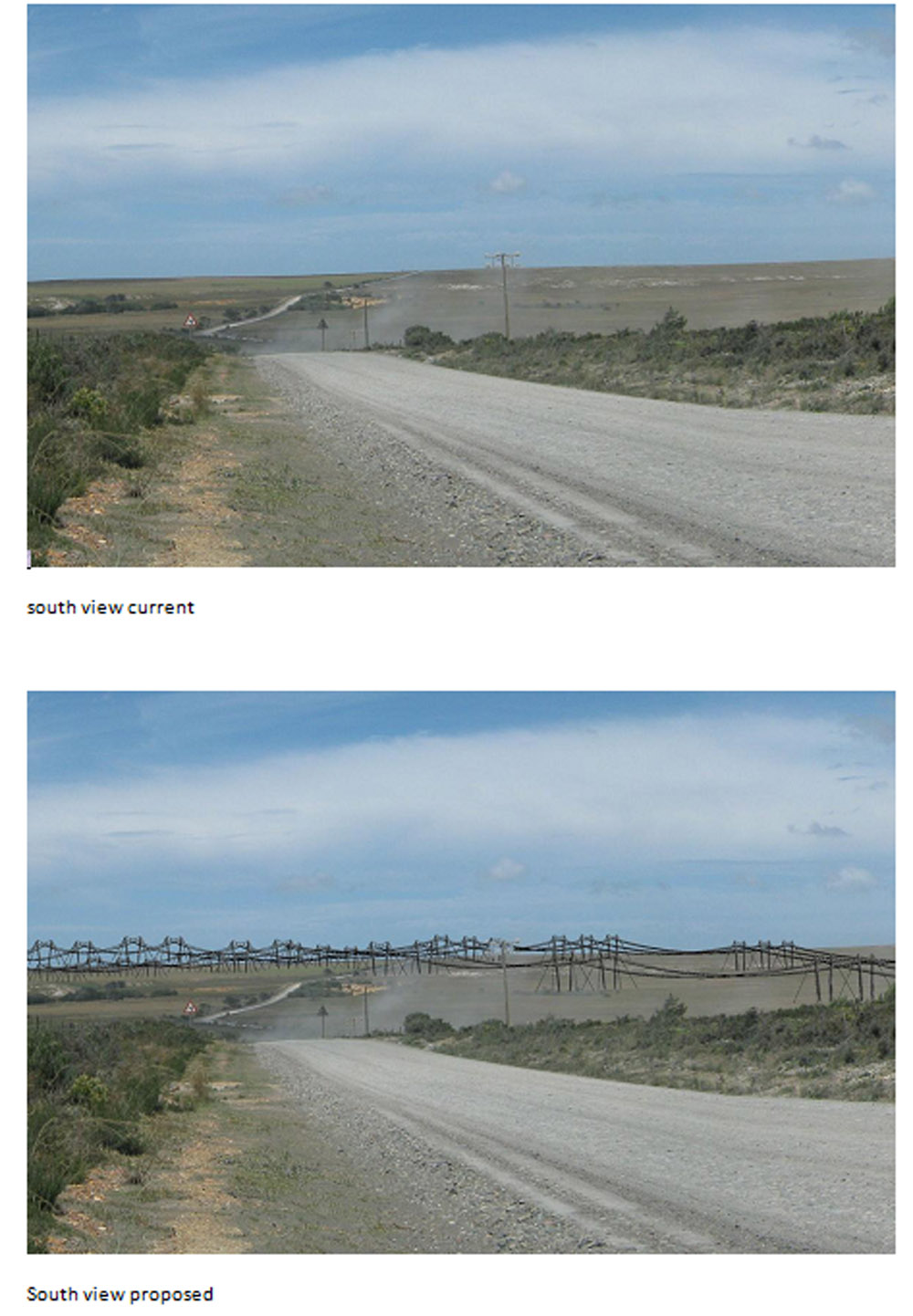
Hitlton Thorpe of St Francis Bay Residents’ Association has requested these photos of transmission lines planned for Thyspunt be published .
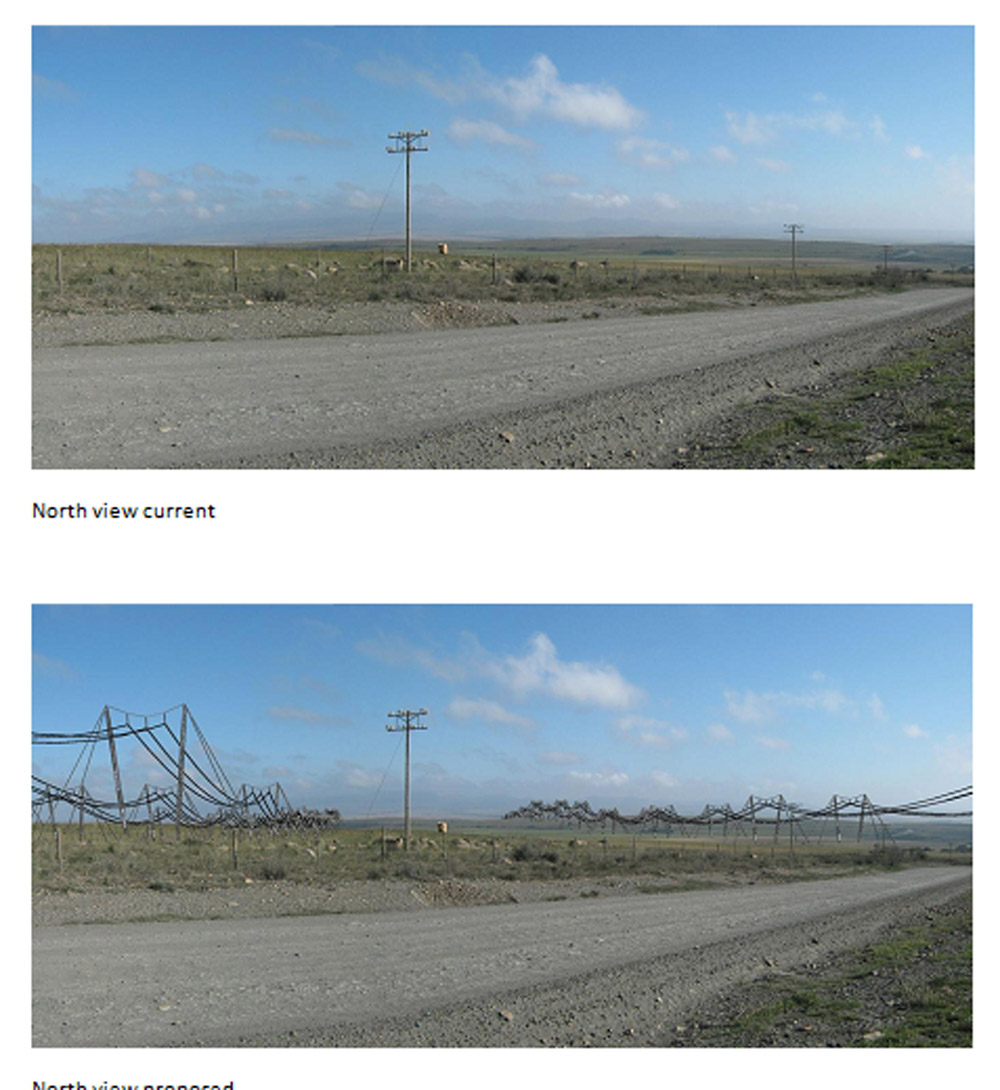
These photos are supplied in the current Revised Draft Environmental Impact Report. Thorpe has , however, said this photos are also misleading – after it was said the photo published in St Francis Chronicle was also misleading.
These photos are misleading according to Thorpe becasue transmission lines are higher than telephone poles and in these photos (supplied b Sivest) the lines are the same height as the the telephone poles!
not having these photos at the time of going to press before the November print edition, a photo of transmission lines in Germany was used by St Francis Chronicle to illustrate a letter/article to The Editor by Thorpe.
According to Thorpe, the article (letter) was accompanied by a picture of “monstrous transmission lines” somewhere in Germany. “The picture is misleading and needs to be corrected,” Thorpe says. “It bears no resemblance to the ones which are planned for Thyspunt, and which were supplied in the Revised Draft Environmental Impact Report.”
Thorpe then provided the Sivest photos, above, showing the probable impact on the Oyster Bay/Humansdorp Road. (The Editor apologises for using an incorrect photo to illustrate the ‘Letter to the Editor’ – the error is regretted and was not intended to be “misleading”. A Sivest photo (that Thorpe says is misleading) has been used in the online edition.)
The following is Thorpe’s letter/ article sent to the Editor:
The full impact of the proposed transmission lines to link the High Voltage Yard at Thyspunt with the substations in Port Elizabeth is now known. It is a horror story of note.
These highly visible lines will run for 150 kilometres, much of it through natural, visually sensitive landscape with very low visual absorption capacity. There will be five lines, each 40 metres high, with pylons every 400 metres. For much of the route they will run in two corridors, known as the northern and southern corridors. The northern will comprise three lines and be 275 metres wide. The southern will comprise two lines, and be 165 metres wide. However, between the High Voltage Yard and Humansdorp they will run in parallel, with a combined width of nearly half a kilometre.
From here it will run within less than a kilometre around Kruisfontein, continuing across the Humansdorp-Hankey road, dropping into the Gamtoos Valley. From there is will continue past Loerie into the Elands River Valley and from there to Port Elizabeth.
The visual impact of this will be massive, unmitigable and permanent. It will change for ever the visual character of a sizeable part of the Kouga area. The impact on Kruisfontein will be catastrophic.
The EIA for this component of the Nuclear 1 project is at an advanced stage. It is this document which will be used by the decision-making authority, the National Department of the Environment, to determine a Record of Decision.
The full Revised Draft Environmental Report is available for public scrutiny and response in the Library at St Francis Bay (Tuesdays & Thursdays, 9.30 – 12; Fridays 2–4; Saturdays, 10–12). CDs are available from Hilton Thorpe (042 294 0282; 0836608909) and Shirley Cowling (042 298 0259). Closing date for comment is 22 November, 2012.
The DEIR is a formidable document, comprising 6 volumes, and covering 11 specialist reports on a variety of impacts, including geology & geo-hydrology, avifauna (birds), surface water, biodiversity, visual impact, socio-economic, tourism, heritage & palaeontology, Khoi-San Heritage, agriculture and an assessment of the proposed ne substation in PE.
For most residents in the Greater St Francis & Oyster Bay area the most important of these is the Visual Impact Assessment. This can be found in Appendix 8, in the third volume. The photos shown here are taken from pages 81 & 83 of Appendix 8. These depict the current and proposed views along the Oyster Bay-Humansdorp road, looking north and south. This is just one of the massive negative environmental impacts which will occur should the Nuclear 1 project at Thyspunt go ahead.
In terms of the National Environment Management Act (NEMA), a project cannot go ahead if fatal flaws are identified (high impact, long-term.and cannot be mitigated). By mitigation is meant measures taken to reduce the impact to acceptable levels. All of these three criteria apply to long sections of the proposed lines, and the Department of the Environmental Affairs – the decision-making authority – is obliged to take these into account in giving a Record of Decision.
Members of the public who are concerned about this sort of environmental vandalism have the opportunity to comment by not later than 22 November to Sivest, PO Box 2921, Rivonia, 2012, attention Chris le Roux or Themba Skonje. The email address is thuyspuntlines@sivest.co.za.
Since the EIA process is at an advanced stage, comment can now only be made on what appears in the Draft EIR, and must be properly motivated. The strongest argument residents have is that the impact will be unacceptably high, unmitigable and permanent, resulting in a fatal flaw. It can also be argued that the transmission lines are part of the cumulative environmental impact of the entire Nuclear 1 project, and that they cannot therefore be treated separately from the EIA for the Thyspunt site itself.
It is a mistake to believe that individual input will be ignored, especially if enough people register their objections. Already the route proposed for the southern corridor across the Kromme above River Tides has been rejected, following objections by I & A Ps. If issues such as these are not raised, the community has only itself to blame when destructive developments take place – Hilton Thorpe.
 St Francis Chronicle
So because you privileged few want a good view of dirt roads and farms, people living with out electricity must suffer.
Wonder what a tragedy it will be when someone you know and love dies in a hospital due to power failures? or doesn’t that happen in rich peoples hospitals?
The irony of this is that it has been discovered that the photos used in the EIA report (and published here) are “misleading” themselves as they are the same size as telephone poles in the report. The report has to now include corrected photos as the pylons for transmission lines are far higher than telephone poles!