

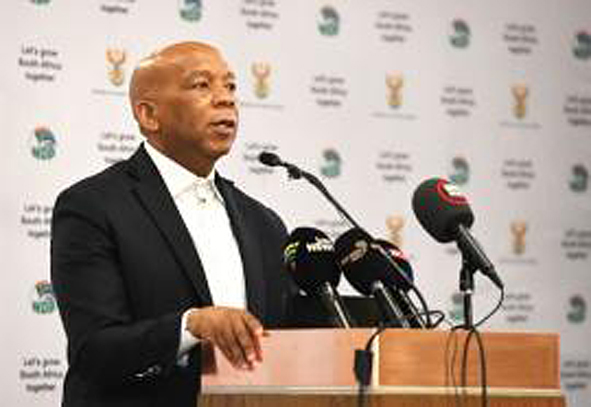
Sunday 19 October: St Francis Chronicle edited: An Integrated Resource Plan (IRP) 2025 aimed at resolving SA’s electricity crisis, improving the country’s economy and that will see a dramatic shift in the country’s energy mix – with cleaner energy sources like hydro, nuclear, and wind – was announced to the Press today
Ramokgopa believes human development has a relationship with GDP growth. “For as long as there is no electricity, for as long as the lights are off, we are going to undermine the country’s potential to achieve its ambitions of growth and ensure that we can attract the necessary investments, and then that the people of this country can grow at levels that our potential dictates.
“That’s what we are resolving now. It’s not just about the megawatts. We are constructing a story about how we’re going to get the South African economy back on its feet.”
The strategy also commits to significant emissions reductions, targeting approximately 160 million tonnes of carbon dioxide (CO2) equivalent by 2030, declining to 142 million tonnes by 2035.
The SA Govenment’s R2.2-trillion is about 30% of the nation’s gross domestic product (GDP). This comprehensive energy transformation strategy follows last week’s announcement by Minister in the Presidency, Khumbudzo Ntshavheni, of Cabinet approving a new roadmap.
“As a result of the lights being off, the South African economy has not been able to grow, as they say in economics. Electricity has been a structural constraint to the South African economy,” Dr Ramokgopa said at a media briefing today.
He highlighted how persistent power shortages have stunted economic development and contributed to high unemployment rates. “Now that we have turned the corner on load shedding, we are addressing the future. Energy now ceases to be a crisis; energy and electricity are going to be a catalyst for growth,” Ramokgopa aid .
The IRP aims to address electricity supply issues, promote economic growth, and create jobs, targeting a 3% GDP growth by 2030. “There is no economy that grows if the lights are off. There are no industries that will decide to locate in South Africa if we can’t guarantee them available electricity that is of good quality and that is affordable.”
The move also introduces a dramatic shift in the country’s energy mix, with cleaner energy sources like hydro, nuclear, wind, and solar set to surpass coal for the first time in the nation’s history.
By 2039, government aims to add 105 000 megawatts of new generation capacity – effectively building Eskom “two and a half times” its current size.
Key highlights include 11 270 megawatts of solar photovoltaics (PV) by 2030; 7 340 megawatts of wind energy; 6 000 megawatts of gas-to-power, and 5 200 megawatts of new nuclear capacity.
Currently, 58% of installed capacity comes from coal, with 10% from rooftop PV, 10% from grid-connected solar PV, 8% from wind, and 3% from nuclear sources.
The Minister also acknowledged two primary challenges, including a limited skills pipeline and a decimated construction industry.
However, Dr Ramokgopa stressed the government remains committed to transforming South Africa’s energy landscape and creating economic opportunities. “This is not just an electricity programme, but a response to an economic question,” he said.
He underscored the plan’s broader ambitions of economic revival and job creation. “We’re talking about growth, industrialisation, new skills, and resuscitating collapsed industries,” he said.
The Minister also took the time to stress the plan’s energy security, reducing load shedding, and ensuring affordable electricity.
“We want to ensure that each household has access to this electricity, and this electricity is affordable, and we can guarantee it into the future. That’s the point that we are making.”
The Minister also announced that Eskom has already shown promising improvements, with the energy availability factor rising from 48% during peak load shedding to around 70% currently, providing a strong foundation for the ambitious energy transformation. Source: SAnews edited
See more photos and local stories online at kougachronicle.co.za
 St Francis Chronicle